ALL IN ONE SEO TOOLS
All in one SEO tools that tell you what to do next
Most SEO suites report data and leave the next step to you. These tools answer it: keyword research, briefs, page scans, internal links, rank tracking, audits, AI visibility, leads and reports, all reading from the same data. Each tool answers one question and hands the answer to the next, ending in a ranked fix list for each page, so you spend your time fixing pages instead of copying numbers between tabs.
Developed by Vertical Web, a Houston SEO agency since 1998, and Beth Guide, with more than 20 years of SEO experience.
WHY ONE PLATFORM
Five separate tools give you five versions of the truth
Most teams stitch together a keyword tool, a rank tracker, an audit crawler, a content editor and a reporting dashboard. Each one counts things a little differently. The keyword you researched in one tab is not the keyword the editor scored in another, and nobody remembers which page was meant to link to which.
We hit that wall on our own client work. elev8tor started as the console our agency built so a keyword, its brief, the page written from it, the links pointing to it and its ranking history all live on one record. Every client page Vertical Web publishes is scanned by the platform before it ships. The tools below are the ones we use on that work every week.
THE TOOL SUITE
Each tool, and the decision it helps you make
A tool is only useful if it changes what you do next. Here is what each one does and the call it helps you make. Need a deeper look at crawling and fixes? See our SEO audit tool page.
Keyword research
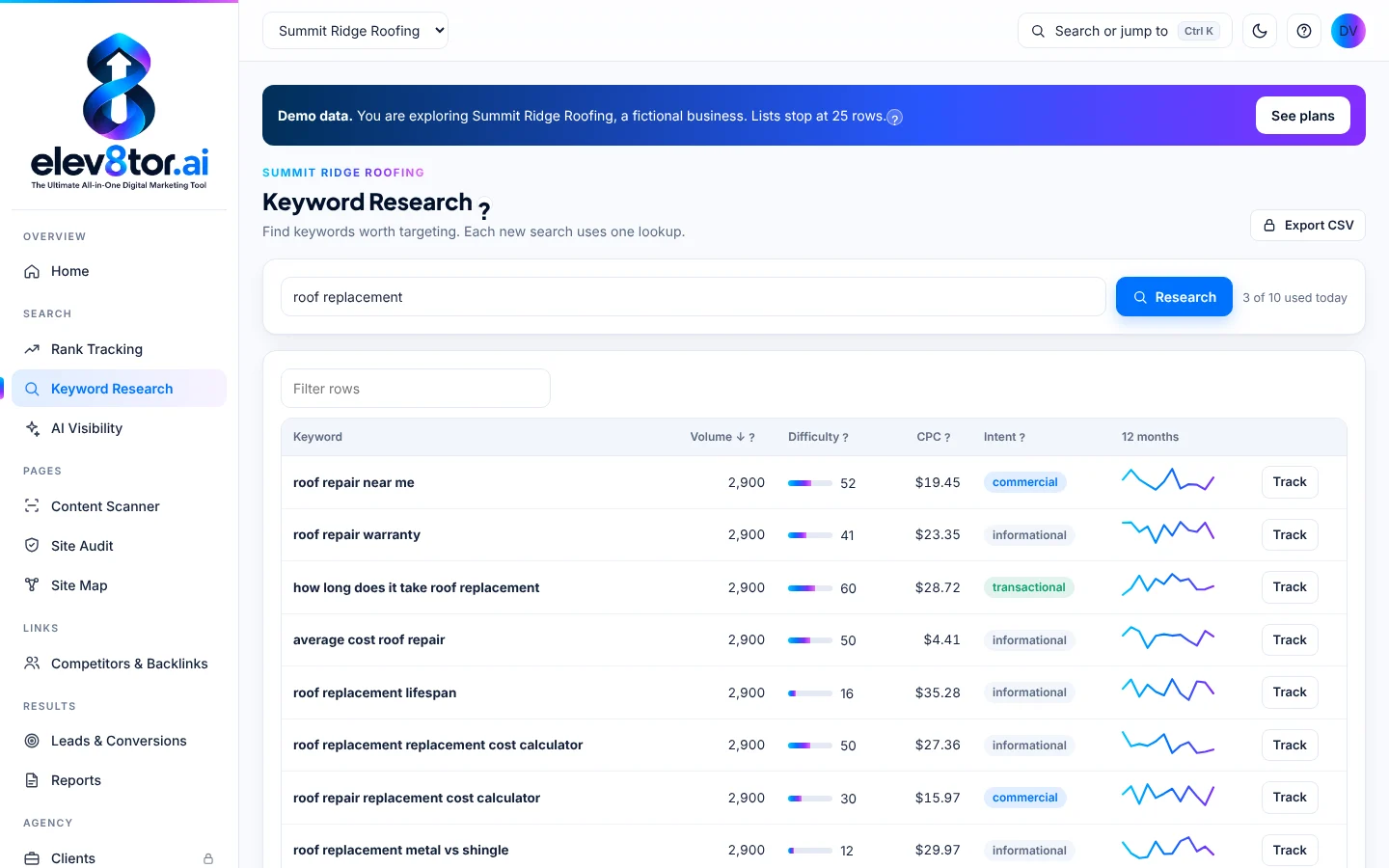
Volume, difficulty, intent and the pages ranking now. Decision: is this keyword worth a page, and can this site compete for it?
Keyword briefs
A keyword read with no page yet: Google's category for each top result, entities, questions, word count range, headings and schema. Decision: what must the new page cover?
Content Scanner
Scores a live page against today's top 10 with a Content score target of 70 and a ranked action plan. Decision: which edits move this page most?
Internal link strength
Every page from weakest to strongest, with the pages that should link to it. Decision: which pages need links before they need new words?
Interactive site map
Pages grouped into topic hubs, shown in red where they do not link up, plus gap pages to build. Decision: what to build next and where it belongs.
Rank tracking
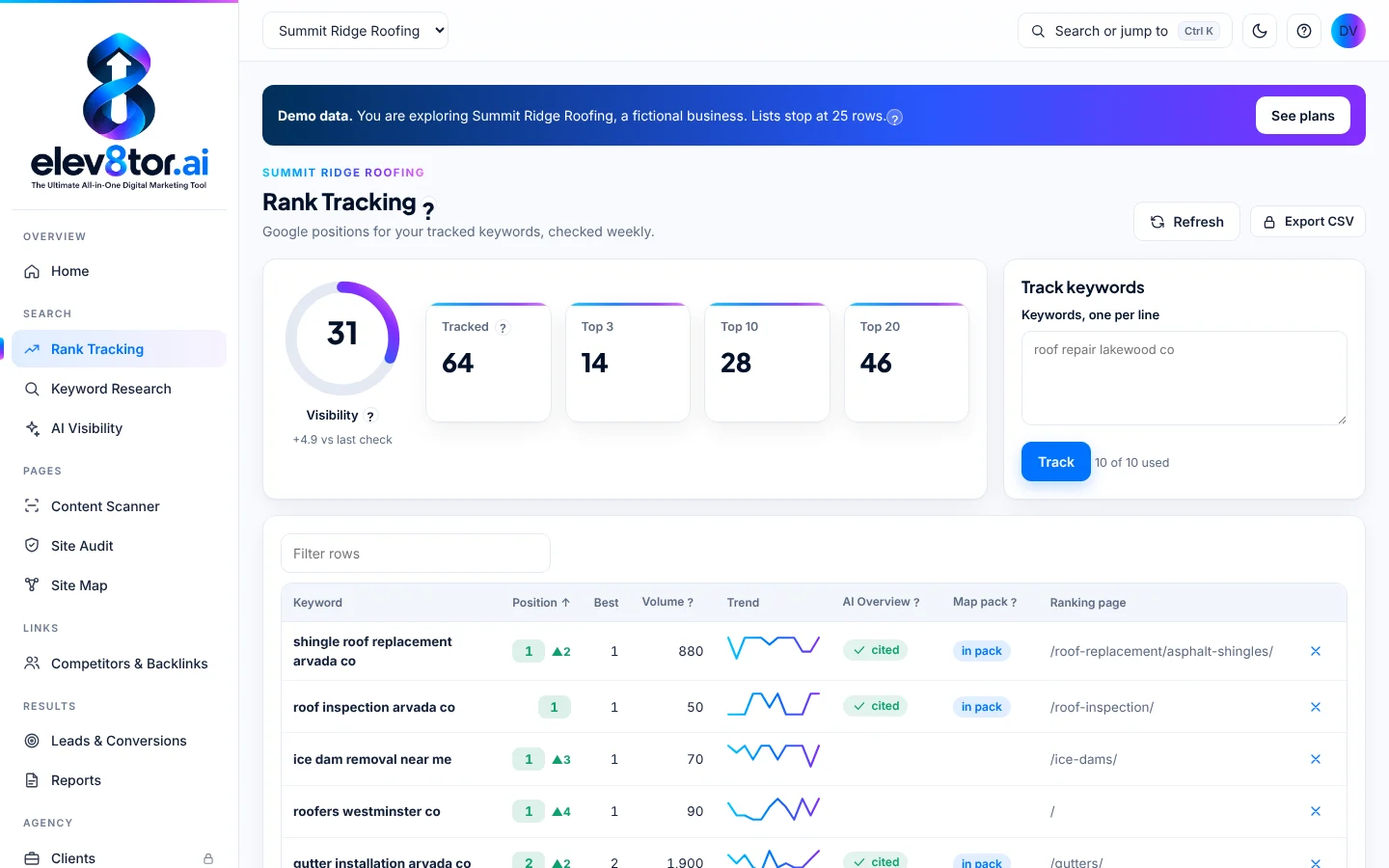
Every tracked keyword with AI Overview, map pack and featured snippet placements, movers, lost keywords and a visibility score. Decision: what changed and whether it matters.
Site audit
Crawl errors, titles, meta descriptions, H tags and indexability, each with How to fix in plain words. Decision: what is technically holding pages back?
Competitors and backlinks
Rivals side by side, pages they have that you do not, referring domains with a spam filter, and Win a keyword. Decision: what the pages beating you have that you lack.
AI visibility
Keywords that show an AI Overview, who it cites and whether AI crawlers can read your pages. Decision: where you could be cited and what blocks you.
Watchers and drop analyzer
Nightly checks for traffic drops, GA4 that stopped counting, broken pages with Google traffic and keywords leaving the top 10. Decision: what broke overnight.
Leads and GA4
Every form, call tap, email tap and order with its source, sent to GA4 as a conversion. Decision: which pages and searches produce customers.
Work queue and reports
What to work on next, ranked by value, plus automatic weekly and monthly reports and client portals. Decision: what to do this week and how to show it.
HOW THE TOOLS CONNECT
Keyword, brief, scan, link, track
The tools are built as a chain. The output of each step is the input to the next, so nothing gets retyped and nothing gets lost.
01
Keyword
Pick a keyword from research, a competitor gap or a red gap on the site map, and attach it to a page or a planned page.
02
Brief
The brief reads the top results and lists the entities, questions, headings and word count range the new page needs.
03
Scan
Once the page exists, the scanner scores it against today’s top 10 and ranks each fix by the points it is worth.
04
Link
Link strength names the pages that should point to it, with the exact sentence and anchor text for each link.
05
Track
Rank tracking, AI visibility and leads report whether the page moved and whether it produced business.
The scan step is where most of the work gets decided, so we wrote a full page on the content scanner. The track step feeds both the client report and the work queue, so a page that slips out of the top 10 shows up as a task the next morning.
A REAL EXAMPLE
What one keyword looks like moving through the chain
Say a roofing contractor wants to rank for storm damage roof repair. Research shows the volume and that the ranking pages are local service pages, not blog posts. The brief lists the entities those pages share, such as insurance claims, hail, inspections and adjusters, and the questions searchers ask in People Also Ask.
After the page is written, suppose the scan shows it sits below the target of 70, leaves a couple of questions unanswered and has only one internal link pointing at it. The action plan says which fix is worth the most points. Link strength names three existing pages that should link to it and the sentence to use on each. Two weeks later rank tracking shows the movement and the leads report shows whether calls came from it. Every number in that story lives on one record.
DATA INCLUDED VS BRING YOUR OWN DATA
Same tools, two ways to pay for the data
Every tool on this page runs on three kinds of data: search data from DataForSEO, traffic and indexing data from your Google accounts, and AI analysis from Anthropic Claude. You choose who pays for it.
BYO: Bring Your Own Data
Connect your own DataForSEO, Google and Claude keys. You pay those providers directly at their rates and pay us a flat software fee. Keys are encrypted and never shown again after saving, and each one has a test button. Good for teams that already hold those accounts.
Data Included
We supply and pay for the data, so you sign up and start working. Your plan sets your tracked keywords, research credits and audit pages each month, and usage bars show where you stand before you reach a limit. Good for anyone who would rather not manage API accounts.
Users are unlimited and free either way. The Content Scanner is the exception on both: it always runs on our servers, never on your keys, and is paid in credits, either on its own as Content Scanner only or added to any paid plan. Plan limits and add-ons are listed on the SEO software pricing page.
WHO USES THE SUITE
Agencies run clients. Owners run one site.
Agencies use the workspace to manage many client sites with team roles, client viewer logins and reports under their own brand. That side of the platform is covered on our agency SEO platform page, and the branded reports on white label SEO reporting.
Owners get the same engine with help videos, tooltips on every metric and a guided tour on first login. If you run one business and want to see which pages bring calls, start with small business SEO software and lead tracking with GA4. Comparing tools before you switch? Read our honest Semrush alternative comparison.
FAQ
Frequently asked questions
All in one SEO tools put rank tracking, keyword research, site audits, content scoring, competitor research and reporting in one login that shares one set of data. In elev8tor that also includes a site map of topic hubs, AI visibility checks and lead tracking that sends conversions to GA4.
Open the work queue, called What to work on next. It ranks open tasks across every tool by their likely value, so the first item is usually the best use of your next hour. If the site is new to elev8tor, run the site audit and the site map first so the queue has something to rank.
No. Many owners start with rank tracking, the site audit and lead tracking. Agencies usually add the Content Scanner, competitor research and white label reports. Every plan includes the same modules, unlimited free users and, on paid plans, unlimited verified sites; plans differ by data limits such as tracked keywords and research credits a month.
It is part of the platform but always paid on demand in credits, because it runs on our own servers, never on your API keys. Buy it on its own as Content Scanner only, with no base plan, or add it to any paid plan. The free demo includes 5 real scans, one time, so you can try it on your own pages first.
Search data comes from DataForSEO, traffic and indexing data from your connected Google accounts, and writing and analysis from Anthropic Claude. On Bring Your Own Data plans you connect those accounts yourself. On Data Included plans we supply the data.
Yes, on paid plans. The free demo has no exports and lists stop at 25 rows, so you can explore every screen before you choose a plan.
Open the whole suite with sample data
The free demo loads a sample workspace for a fictional roofing company, Summit Ridge Roofing, so you can click through every tool before you pick a plan.
Related pages
- SEO audit tool: Site and page audits with fixes in plain words
- Content scanner: Score and repair a page against today’s top 10
- AI search optimization: Findability for AI Overviews and AI crawlers
- SEO software pricing: Data Included and BYO plans, credits and limits
- Semrush alternative: A fair side-by-side comparison