BUILT FOR AI OVERVIEWS, CHATGPT, PERPLEXITY AND GEMINI
AI search optimization that tells you what to change next
AI answers pick sources they can read, trust and cite. elev8tor maps your site, checks whether AI crawlers can reach each page, measures the pages AI Overviews already cite, and gives you the exact fixes and links that make your pages a better source.
Developed by Vertical Web, a Houston SEO agency since 1998, and Beth Guide, with more than 20 years of SEO experience.
WHAT CHANGED
Search now answers before anyone clicks
Google shows an AI Overview at the top of many results. Buyers ask ChatGPT, Perplexity and Gemini to compare vendors and explain options. Each of those answers is assembled from web pages, and the pages chosen tend to share a few traits: they are open to the crawler, the copy is in the HTML, they answer the question directly, they cover the topic the way other trusted sources do, and the site makes it obvious which page is the authority.
Most of that is fixable. The hard part is knowing which page needs which fix, in what order. That is what elev8tor is built to answer.
NOT JUST A TRACKER
Tracking shows the problem. elev8tor shows the fix.
An AI tracker tells you that a competitor was cited and you were not. Useful, but it stops there. elev8tor carries on to the page level: which entities and questions the cited pages cover that yours does not, whether your page is even crawlable by the bot in question, and which internal links would tell search engines your page is the one to trust. Then it wires the page into the site with the exact sentence and anchor for each link. The page level work runs through our SEO content scanner, and the technical side through a full SEO audit.
OUR MAPPING PROCESS
Eight steps, in the order we run them
This is the sequence the platform walks you through, and the same order our agency follows on client sites. Each step uses a module you can open in the app.
01
Map the site
Crawl the site into topic hubs and the pages under them. Red marks pages that do not link up to their hub.
02
Check findability
Find noindex tags, canonicals pointing elsewhere, AI crawlers blocked in robots.txt and copy that only appears after JavaScript.
03
Find the AI keywords
List which tracked keywords show an AI Overview and which sources it cites today.
04
Read the cited pages
Scan the top 10 for each keyword: categories, entities on two or more sites, questions and structure.
05
Score and repair
Score your page against that cohort and work the ranked action plan, highest points first.
06
Build the gap pages
Turn each search with no page into a keyword brief, then write or draft the page.
07
Wire links up, down and across
Add the links each page needs, using internal link strength and the exact sentence and anchor the scanner suggests.
08
Get listed and watch
Pursue the AI source targets, then let nightly watchers flag new AI Overviews, drops and keywords leaving the top 10.
SITE MAPPING
Your site as topic hubs, with the gaps marked
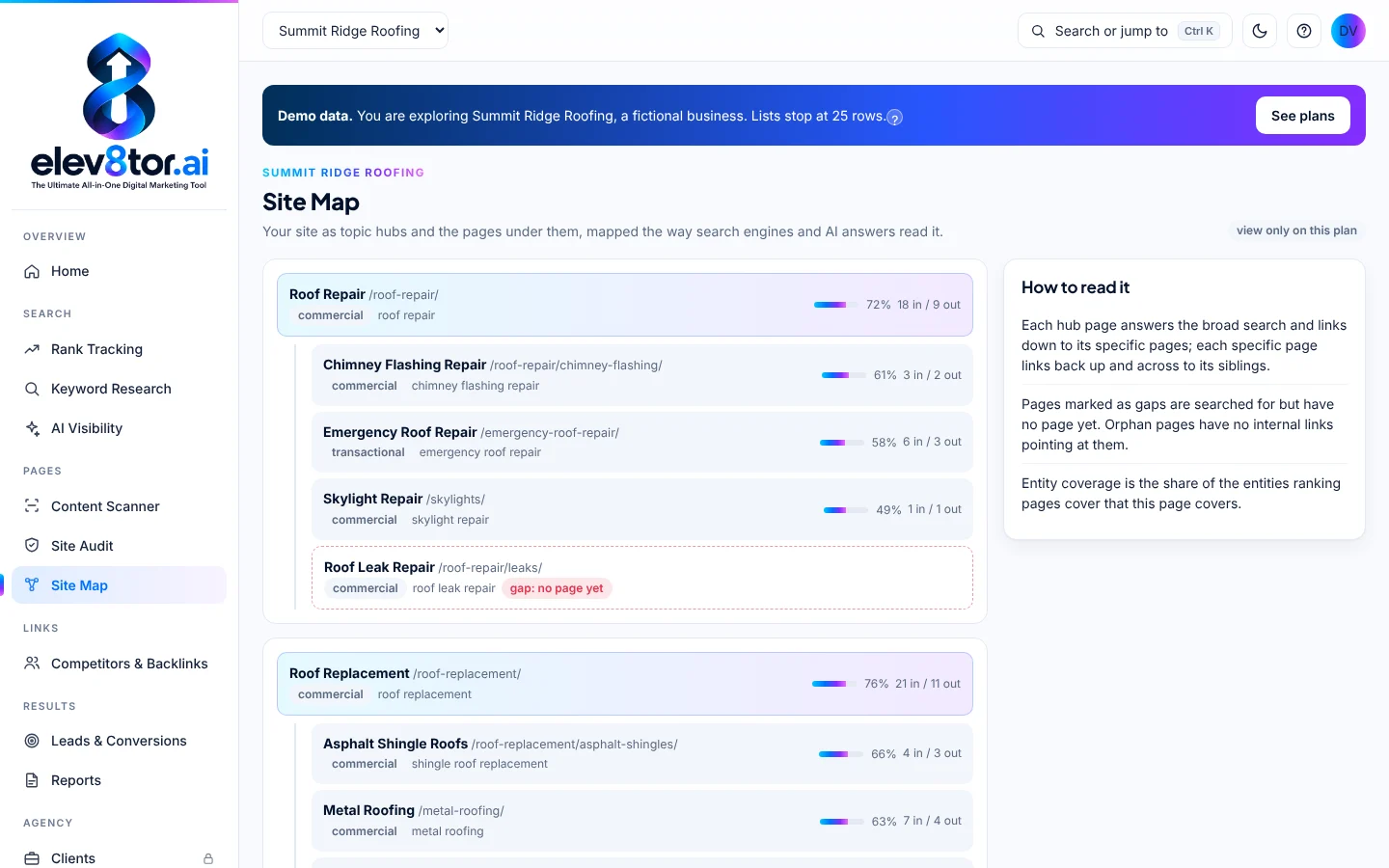
The interactive site map groups your pages into topic hubs and shows how they link. Pages that do not link up to their hub show in red. Searches with no page yet appear as gap pages to build. Internal link strength ranks every page weakest to strongest and lists the pages that should link to it.
This matters for AI answers because a clear hub tells every crawler which page is your authority on a topic. A site where ten pages half cover the same subject sends a weaker signal than one strong page supported by ten focused ones. You can print the outline and hand it to a writer.
AI CRAWLER ACCESS
Can the bots actually read your page?
A page cannot be cited by a system that is not allowed to fetch it. Every scan checks robots.txt for each crawler separately and reports how much of your copy is in the HTML before JavaScript runs, since many AI crawlers do not run scripts.
- Googlebot and Bingbot: classic search crawling, which AI Overviews and Bing’s AI answers build on.
- OAI-SearchBot and ChatGPT-User: fetch pages for ChatGPT search results and for requests a user makes.
- GPTBot and Google-Extended: relate to model training. Google-Extended does not change how Googlebot crawls for Search.
- PerplexityBot and ClaudeBot: the crawlers used by Perplexity and Anthropic.
We report each one on its own line so you can make the business decision about training access without accidentally blocking the search bots you want.
AI VISIBILITY
Who AI Overviews cite, and where you could be listed
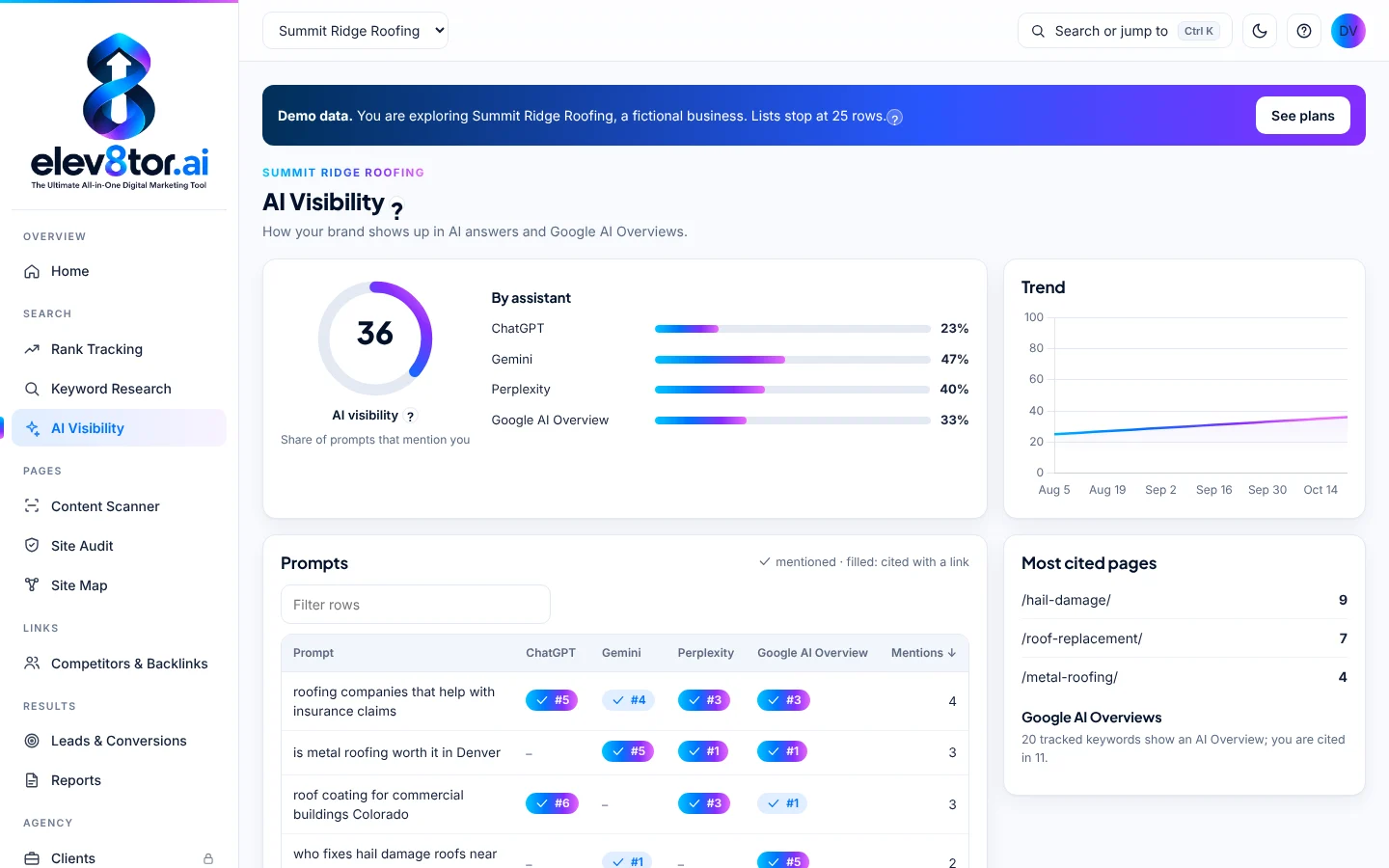
The AI visibility module shows which of your keywords trigger an AI Overview and which sources it cites. The scanner adds an AI Visibility score from 0 to 100, kept separate from the Content score so a crawler problem never hides behind good copy.
It also lists AI source targets: the sites Google’s AI Overview draws on for that keyword, where your business could earn a listing. For local businesses, the local search type filters map pack results and directories so the targets match your market. Every alert comes with plain-language steps, and agencies can send the results in white label SEO reporting.
HONEST LIMITS
What no tool can promise
No tool can promise an AI citation. AI answers change by query, location, user and day, and the companies behind them do not publish how sources are selected. The AI pickup predictions in a scan are labeled estimates until they are calibrated against real outcomes.
What we can do is remove the reasons a page gets passed over, measure the pages that are cited, and track whether yours starts to appear. Then tie it to revenue: GA4 lead tracking shows which pages and channels bring in leads, so you judge the work by results, not screenshots.
WHO IT FITS
Agencies, owners and in-house teams
Agencies run this process across every client from the agency SEO platform. Owners get the same steps with tooltips and help videos through our small business SEO software. Everyone can see the full list of SEO tools or compare plans on the pricing page.
FAQ
Frequently asked questions
AI search optimization is the work of making your pages easy for AI answers to find, read, trust and cite. That covers Google AI Overviews, ChatGPT, Perplexity and Gemini. In practice it means crawler access, copy that is readable without JavaScript, full topic coverage, direct answers to real questions, and a site structure that shows which page is the authority on each topic.
No, and no tool can. AI answers change by query, user, location and day, and the companies running them do not publish how sources are picked. We show you what is measurable, close the gaps the cited pages do not have, and track whether your pages start appearing.
It builds on it. AI Overviews draw heavily on pages that already rank, so the fundamentals still matter. The added work is checking AI crawler access, answering questions directly, covering the entities the cited pages share and getting listed on the sites AI answers draw from.
That is a business decision. GPTBot and Google-Extended relate to model training. OAI-SearchBot and ChatGPT-User fetch pages for ChatGPT search and user requests. Blocking the wrong one can keep you out of answers you want to be in, so the scanner shows each one separately.
The AI visibility module tracks which of your keywords show a Google AI Overview and which sources it cites. Crawler checks cover the bots used by OpenAI, Perplexity, Anthropic and Google. Your plan sets how many AI visibility prompts you can run each month.
The site map, AI visibility and crawler checks are part of the platform. The page by page scoring and repair step uses the Content Scanner, which you can buy on its own or add to any paid plan.
See the mapping process on a real workspace
The free demo opens a sample site with its map, AI visibility and crawler checks. Explore every screen before you choose a plan.
Related pages
- Content Scanner: Score and repair a page against today’s top 10
- SEO audit: Crawl errors, indexability and fixes in plain words
- Lead tracking and GA4: Tie visibility to the leads it brings in
- SEO tools: Every module in the platform
- Free demo: Explore a sample workspace