WHY ELEV8TOR IS DIFFERENT
The SEO scanner built to tell you how to rank
Most SEO scanners give you a score and a pile of data. elev8tor was designed to answer the question that comes next: what do I do now? It scores your page against today’s Google top 10, estimates where it will land, and hands you a ranked fix list with the exact sentences and anchors. Each choice behind that is a design decision from Beth Guide’s 20+ years of SEO.
Developed by Vertical Web, a Houston SEO agency since 1998, and Beth Guide, with more than 20 years of SEO experience.
THE PROBLEM WITH MORE DATA
Why a pile of SEO data does not tell you how to rank
Open most SEO scanners and you get fifty items of equal weight: terms to add, a word count, a readability grade, a speed score, a list of pages that might link to you. Every item is true. None of them tells you which three changes will move the page, so the decision is still yours, and most people either change nothing or rewrite the page and lose what was working.
At Vertical Web we hit that wall on our own client work. The agency has done SEO since 1998, and Beth Guide had spent more than 20 years answering one question for clients: what do we fix next? So when the agency built its internal SEO Console, she set one rule for the scanner inside it. Every number must lead to an action, and every action must carry a value. That console became elev8tor, and the scanner is the SEO content scanner every client page passes through before it goes live.
THE DESIGN DECISIONS
Twelve choices that turn a scan into an answer
These are the decisions that shape what the SEO scanner reads, what it ignores and what it hands back. Each one replaces something most scanners do by default.
01
Read the category before the copy
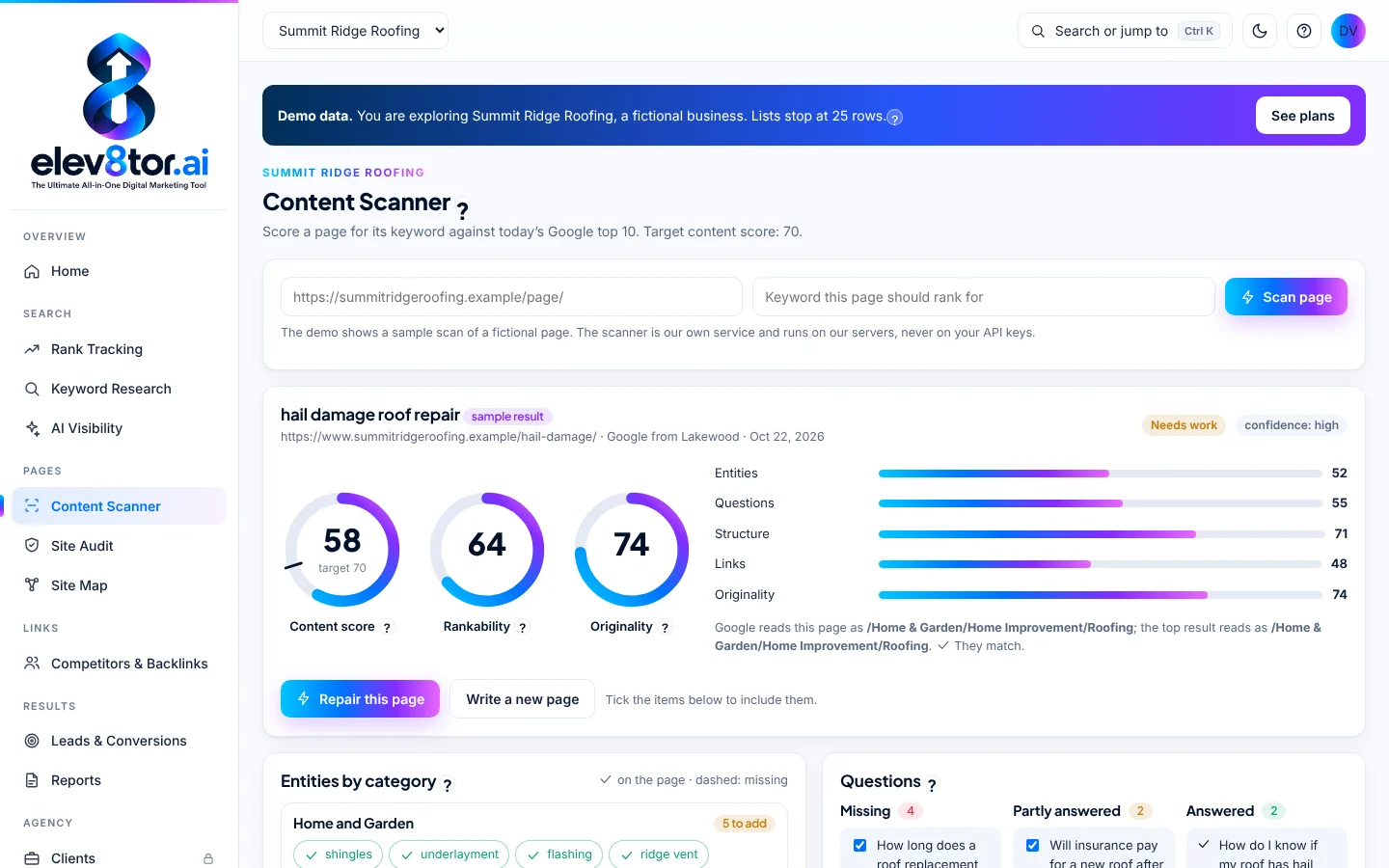
Most scanners go straight to terms. Ours first runs your page and every page on page one through Google’s Natural Language categories. If Google files your page somewhere else, the scan says so before anything else, because no number of added terms fixes a page Google thinks is about a different topic. The fix is the framing: title, opening and headings.
02
Count an entity only when two or more sites use it
A term that shows up on one ranking site is usually that site’s brand, staff name or product. Counting it sends you chasing a competitor’s vocabulary. Entities are grouped by category and kept only when they appear on at least two different websites.
03
Ranges from the ranking pages, not fixed counts
Telling you to use a word three times is guesswork. The density target comes from the ranking pages’ own range, the 25th to 75th percentile per 1,000 words, and an over-optimization check flags terms pushed past what page one uses.
04
Leave image alt text out of the count
Alt text is for people who cannot see the image. Counting it rewards stuffing keywords into alt attributes, an edit that helps no reader. The scanner reads the copy people actually read.
05
Questions answered, partly answered or missing
Most pages touch a question without answering it. Questions come from People Also Ask and the ranking pages, and each one is marked answered, partly answered or missing, so you know which ones need a full answer and which need one more sentence.
06
Links with the exact sentence and anchor
A list of pages that should link to you is still homework. Each internal link suggestion names the page, the exact sentence and the anchor text. Weak anchors such as learn more are flagged with a better one.
07
Originality and a non-commodity review
A page that rewords the top 10 matches page one and gives Google no reason to rank it. The scan reports an originality score and terms found beyond page one, and the review asks for what only you can supply: first-hand experience, your own process, real numbers and examples.
08
A target of 70, not 100
A score of 100 would mean copying the ranking pages term for term. A Content score of 70 shows the page covers what page one agrees on and leaves room for the original material that makes it worth ranking.
09
Rankability counts internal link support
A strong page with no links pointing to it is hard for Google to find and weigh. Rankability adds your internal link support to the Content score, so a well written orphan page does not look finished.
10
AI Visibility kept separate
A page can be well written and still blocked from AI crawlers. Mixing the two into one number hides both problems, so AI Visibility runs 0 to 100 on its own.
11
Local or national, with the map pack
A plumber in Houston does not compete with a national directory. The local and national switch filters directories out of local comparisons and checks the map pack, so you compare against the businesses you actually compete with.
12
Page speed deliberately not scored
Speed matters, but it belongs in a site audit. Folding it into a content score would hide what the copy itself needs, and a fast page with thin content still does not rank.
THE OUTPUT
A ranked action plan, not a report
Every scan ends in one ranked action plan. Each step says what to change and where, shows the points it adds and the score you reach if you finish it, so you can stop at 70 instead of rewriting a page that only needs four sentences and two links.
From there you choose: Repair this page fixes the existing page in place from the plan, and Write a new page builds a full draft from the keyword brief. Both are drafts for a person to review. Nothing publishes on its own.
Findability is part of every scan: a noindex tag, a canonical pointing elsewhere, robots.txt access for Googlebot, Bingbot, OAI-SearchBot, ChatGPT-User, GPTBot, PerplexityBot, ClaudeBot and Google-Extended, and how much of your copy is in the HTML before JavaScript runs. The wider method is on our AI search optimization page.
FROM ANSWERS TO ACTION
The scanner is the gate; the agent does the work
Answering how to rank was the first job. The second is doing the work without losing the check. Every agentic step in elev8tor runs through the scanner: the brief is read from today’s top 10, the draft is scored against the same pages, the internal links are the ones the scan named, and Autopilot publishes through your own WordPress connection only when the draft clears 70 and the checks pass. Tools that publish without a score, and tools that score without publishing, are compared on agentic SEO tools compared. How to connect your site, with an application password and no plugin, is on the help desk.
PREDICTIONS, LABELED HONESTLY
Where the page will land, as an estimate you can check
A fix list is more useful when you know what it is likely to buy you. Each scan estimates where the page will rank among the pages it read and how likely Google’s AI Overview is to pick it up. Both are labeled as estimates, because that is what they are.
To keep them honest, the scanner is checked every month against an internal benchmark of 30 real client pages from 18 client sites. When the scoring changes, the change is dated in our patch notes. We would rather show you a range and how it was tested than a confident number nobody checked.
SIDE BY SIDE
Most scanners compared with elev8tor
A generic comparison, not a dig at any one product. If you are weighing a full research suite, our Semrush alternative page lines up published plans and says where the big suites are stronger.
Most scanners
- A score and a long list of terms with equal weight
- Fixed counts: use this word three times
- Every term on any ranking page, brand names included
- Alt text counted toward coverage
- Page speed and AI readiness blended into one number
- Internal links left as a to-do
elev8tor
- A ranked action plan with the points each step is worth and the score if done
- Density ranges taken from the pages ranking today
- Entities only when two or more different sites use them
- Alt text excluded, so the score reflects the copy
- Content score, Rankability and AI Visibility kept separate
- Each link with the exact sentence and anchor text
WHAT THE SCANNER LEAVES TO YOU
The two parts no scanner can write
The content review Vertical Web teaches and checks has five parts: original, non-commodity, entity coverage, questions answered and linked in with keyword anchors up, down and across. The scanner measures three of those well. The other two, originality and the non-commodity material, come from you: what you have seen on real jobs, your own process, your numbers and your examples. The scan points at the gap; the person who knows the business fills it.
The technical side, from crawl errors to speed, lives in the SEO audit tool, and rank tracking, AI visibility and lead tracking sit beside the scanner in the same set of all in one SEO tools. You can read more about the team on our about elev8tor.ai page.
FAQ
Frequently asked questions
Most SEO scanners report a score and a list of terms. elev8tor ends every scan with a ranked action plan: each step shows the points it is worth and the score you reach if you finish it, with the exact sentences and anchor text for internal links, plus estimates of where the page will rank and whether Google’s AI Overview is likely to cite it.
No. Rank and AI pickup predictions are labeled as estimates. We check the scanner every month against an internal benchmark of 30 real client pages from 18 client sites, and scoring changes are dated in our patch notes. Nobody can promise a ranking.
Alt text describes an image for people who cannot see it. Counting it toward entity coverage rewards keyword stuffing in alt attributes, which helps no reader, so the scanner reads only the copy people read.
Speed belongs in a site audit. Mixing it into a content score would hide what the copy needs, so the elev8tor site audit covers the technical side and the scanner covers the page content.
Beth Guide, who has more than 20 years of SEO experience and develops elev8tor with Vertical Web. The scanner grew out of the internal SEO Console Vertical Web uses on its own client work, where every client page is scanned before it goes live.
Yes. Content Scanner only has no base plan, just credits: $1.50 a credit pay as you go with a 20 credit minimum, or Scanner 50 at $59, Scanner 150 at $149 or Scanner 500 at $399 a month. You can also add the same credits to any paid plan.
Scan one page and see the answer
The free SEO tool demo includes 5 real scans, one time, on your own pages. Then buy Content Scanner only or add credits to any plan on the SEO software pricing page.
Related pages
- SEO content scanner: What a scan measures and what a credit buys
- SEO platform: Everything elev8tor.ai does in one login
- About elev8tor.ai: Vertical Web, Beth Guide and the SEO Console behind the product
- AI search optimization: Findability for AI crawlers and AI Overviews
- Pricing: Plans, Content Scanner only and scanner credits